
A cost breakdown for gym bags at three MOQ tiers, what sets the minimum, and how to tell whether you need the gym range or the duffel range.
What A Gym Bag Manufacturer Quotes At 100, 300 And 1,000 Pieces
A gym bag manufacturer prices the same 45 cm duffel at roughly US$7.40 at 100 pieces, US$6.60 at 300 and US$5.90 at 1,000, ex-works, on a 600D Oxford shell with a #8 zip and a one-colour print. The drop is not a discount: it is the printing setup, the cutting labour and the material wastage spread over more units.
Below 100 pieces the maths stops working, because the fabric mill sells the shell by the roll and the print shop charges a screen setup whether you print 80 pieces or 800. Above 1,000 pieces the curve flattens, and the next saving comes from changing the construction, not the quantity.
The custom gym bags range is quoted on the same arithmetic, and the custom bag manufacturer page covers the vetting step before a quote.
Gym Bag Or Duffel: Which Range Do You Need
The two ranges overlap in the hand and not in the specification.
The gym range is the training bag: a shoe compartment with a vented panel, a wet pocket for a towel, a shoulder strap and often a separate drawstring section. It is designed to sit in a locker and to be carried by someone in kit.
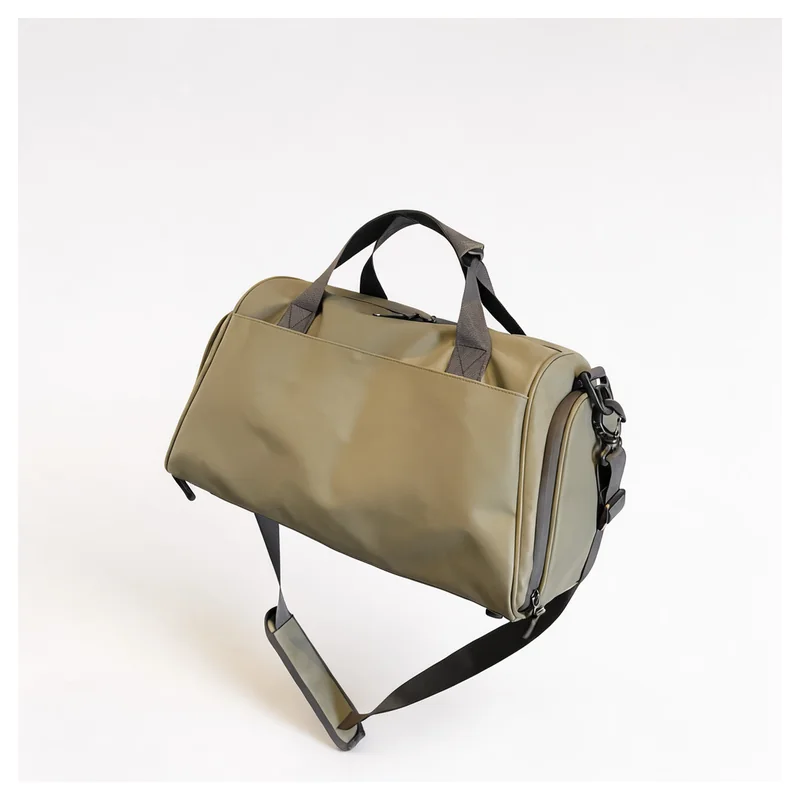
The custom duffel bags range is the barrel and travel shape: a wide curved mouth, two handles, a detachable strap, no shoe vent, and a base built to hold 10 kg for a weekend. If your customer is packing clothes rather than kit, the duffel is the right pattern.
Most brands end up ordering both: a gym bag at 100–300 pieces as the hero, and a duffel at 300+ as the travel addition. The two share the same shell and print, which keeps the colourway consistent and the artwork cheap.
Two ranges, one artwork: because the gym bag and the duffel can share the shell and the print, a brand can order 100 gym bags and 300 duffels and print both from one screen. That is usually cheaper than ordering 400 of either, because the second screen setup disappears and the colourway stays identical across the range.
Where A Gym Bag Manufacturer Spends Your Money
Ask any gym bag manufacturer for a cost breakdown and the honest ones will send something close to this:
| Component | Share of ex-works price | What moves it |
|---|---|---|
| Shell and lining fabric | 38–48% | 600D vs 300D Oxford, PU coating, lining weight |
| Zip and hardware | 10–16% | #5 vs #8 zip, metal vs plastic D-rings, buckles, pullers |
| Labour and stitching | 22–30% | Shoe compartment, vent panel, strap padding, pocket count |
| Logo and printing | 4–9% | Screen print one colour vs embroidery vs rubber patch |
| Packaging | 3–7% | Polybag vs printed box, hangtag, FBA carton labelling |
Freight is quoted separately and is not part of these percentages. A quotation that gives one total number hides which line is expensive, which is exactly the line you need to negotiate.
Packaging is the line buyers forget when they compare quotes: a polybag, a hangtag and a carton label add 3–7% and are often quoted separately. Ask both suppliers to price the same packaging, or the comparison is between a bag in a bag and a bag in a printed box.
What Actually Sets The Minimum Order
The MOQ is not a policy, it is an arithmetic result. Three things set it:
- The fabric roll. A shell colour has to be dyed or bought by the roll; one roll makes 80–150 bags depending on the pattern. Stock colours are already on the shelf, which is why 100 pieces works on stock fabric.
- The print setup. One screen costs the same for 100 or 1,000 pieces, so a second colour doubles the setup and pushes the practical minimum up.
- The cutting table. A marker for a small bag wastes more fabric per unit; the factory will still cut 100, but it charges the wastage.
That is why the honest quote is 100 pieces on stock fabric and 300 pieces for a custom colour — and why a factory that offers 50 pieces in any colour is either losing money or planning to substitute the fabric.
The fabric share explains most of the price spread between quotes: a 300D shell instead of 600D removes roughly 8% of the unit cost and half the abrasion resistance. If two quotes differ by 25% and both claim 600D, one of them is not running 600D — ask for the fabric weight in gsm and the mill name.
How To Compare Two Gym Bag Quotes
Put both quotes next to the same six rows and the difference appears:
- Shell denier and coating
- Zip size and brand
- Shoe compartment: vented panel, full divider, or none
- Strap padding thickness and hardware material
- Print method and number of positions
- Packing: polybag, hangtag, carton marking
A quote that is 30% cheaper almost always differs on rows 1, 2 and 3. Ask the cheaper supplier to quote the same specification as the dearer one, and the gap usually closes to 5–8%.
A fourth, quieter lever is the carton. A gym bag is bulky, so the carton count decides the freight as much as the unit price does. A bag that folds flat packs 30 per carton; the same bag with a rigid base packs 18. On a 3,000 piece order that is 60 cartons versus 100 — worth more than a small unit-price difference.
Sampling And Lead Time For A Custom Gym Bag
Sampling takes 7–10 days plus 3–5 days courier. The first bulk order runs 30–35 days after sample approval; a repeat runs 20–25 days. A shoe compartment or a new strap pattern adds 3–5 days to the sample because the pattern has to be re-cut, not just re-coloured.
Book the sample against a real deadline. A gym bag order that lands in August for a September season is already late, because the factory's line is full of back-to-school work; the same order placed in May has slack and a better price.
Sampling also depends on the shoe compartment. A vented panel pocket samples in the standard 7–10 days; a full divider with a separate zip and a mesh floor adds a pattern piece and 3–5 days. Book the sample against the season, not against the day you finish the brief.
Three Ways To Cut Cost Without Cutting Quality
If the target price is below the quote, change these three things before you change the shell:
- Reduce print positions from three to one. One screen on the front panel saves 3–5% and looks cleaner on a small bag.
- Use a stock lining colour instead of a matched one. The lining is rarely seen; a stock grey or black saves the dye lot and 2–3%.
- Simplify the shoe compartment from a full divider to a vented panel pocket. It keeps the function and removes two operations.
What not to cut: the zip and the strap anchor. Those are the two parts that generate returns, and a return costs more than the saving.
Before the bulk, the bag sample approval routine and the bag fabric guide are the two references worth reading; both apply to a gym bag exactly as they do to a duffel.
Frequently Asked Questions
What is the MOQ for a custom gym bag?
Why is my 1,000-piece price only 10% lower than 300 pieces?
Should I order a gym bag or a duffel bag?
How long is a gym bag sample?
Next Step
Send the style, the quantity and the logo method and we reply with a price band and a sampling date within 12 hours.