
The five construction details that separate a diaper bag that lasts from one that leaks, plus a four-tier comparison of what hardware and fabric you get at each price band.
What A Diaper Bag Manufacturer Should Get Right Before Anything Else
A diaper bag manufacturer is building a bag that is loaded, hung, opened one-handed and wiped clean every day for two years. That use case decides the construction: the straps carry the whole load when the bag hangs from a stroller, the wet compartment has to hold a leak, and the lining has to survive a wipe with a wet cloth. Everything else — print, colour, pocket count — comes after those three.
We make custom diaper bags across backpack, tote and stroller formats, and the five details below are the ones buyers ask about last and complain about first.
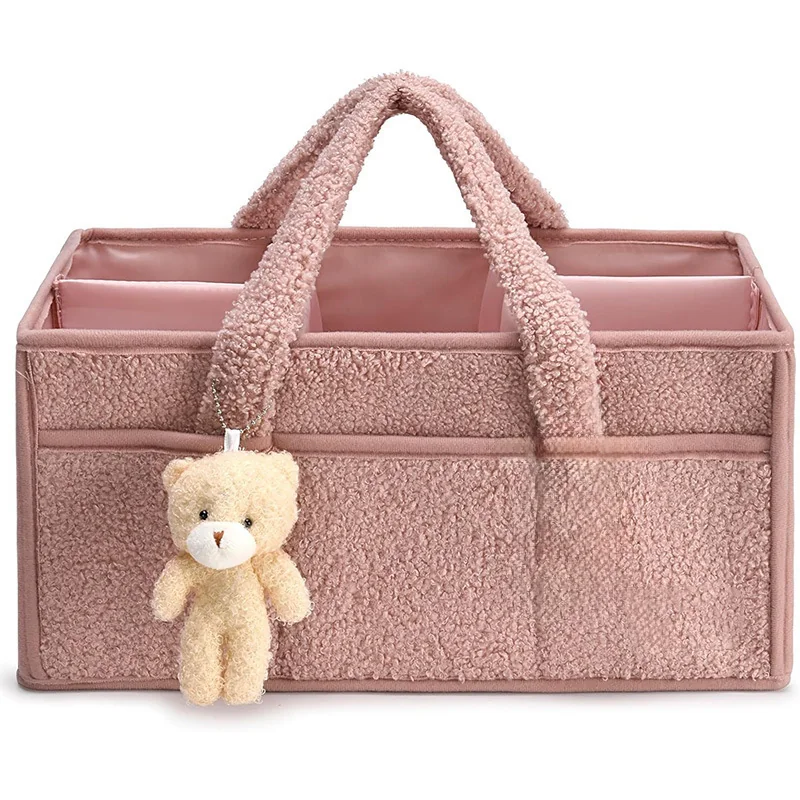
The same logic applies to the smaller pieces: a custom diaper storage bags caddy lives on a changing table and is judged on whether it stands open, not on how it looks folded.
Detail One: Strap Anchoring And Stitch Density
A loaded diaper bag weighs 4–6 kg. The straps are the only thing holding it, and the anchor point is where a cheap bag fails. Look for a box-X stitch through a reinforcement patch at every strap root, not a single row of straight stitch into the shell.
Stitch density matters as much as the pattern: 8–10 stitches per inch on webbing, with a lockstitch and a back-tack at both ends. A bag stitched at 5 per inch looks fine on day one and starts to creep at the anchor after a month of daily use.
The test we run on the sample is a 15 kg static hang for 24 hours with the bag loaded to 6 kg. If a seam starts to open or the webbing stretches, the pattern changes before the order is quoted — not after the first complaint.
The webbing is the other half of the anchoring story. A 25 mm polypropylene webbing stretches under load; a 30 mm webbing with a tighter weave does not. If a quote does not name the webbing width, the answer is usually 25 mm, which is fine for a tote and marginal on a backpack that hangs from a stroller for an hour at a time.
Detail Two: Waterproof Compartments That Stay Waterproof
A wet pocket is easy to add and hard to keep dry. Stitched seams wick water along the thread, so a foil-lined pocket with ordinary seams is a pocket that leaks at the corners within a week.
The build that works is a TPU-coated or foil lining with the seams sealed — heat tape or a welded seam — and the pocket placed outside the main compartment so a leak never reaches the nappies. We test 200 ml of water for 30 minutes on the sample and photograph the result.
If the budget does not stretch to a sealed pocket, a removable wet pouch is the honest alternative: it can be washed separately and replaced. A stitched "waterproof" pocket is the worst of both.
Seam sealing is a machine operation, which is why it shows up in the price. A sealed wet pocket adds two operations and a tape line; a stitched pocket adds none. If the quote does not break out sealing, the pocket is almost certainly stitched — ask for a photo of the inside corner before you approve anything.
Detail Three: Stroller Clips And Bar Diameter
Stroller attachment fails for a boring reason: the clip is sized for a 20 mm bar and the stroller has a 32 mm one. Send the bar diameter with the brief, and the strap or clip is sized to it before the pattern is cut.
The attachment point also needs a reinforcement patch and a rated load. We quote 15 kg static on the clip strap, which covers a loaded bag plus a toddler pulling on it. Plastic clips are acceptable on light totes; on a backpack the clip should be metal or a glass-filled nylon.
One more detail: the clips have to be reachable with one hand while the bag is on your shoulder. That is a sample-stage check, not a drawing-stage one.
Bar diameter is not the only measurement that matters. The distance between the two attachment points decides whether the bag hangs level or swings, and the clip has to sit above the bag's centre of gravity. That is why a sample hanging on an actual stroller tells you more than a drawing with dimensions on it.
Detail Four: Lining, Foam And Smell
The lining is what the customer touches and what holds the smell. A 210D polyester taffeta wipes clean and does not hold odour; a cheap non-woven lining pills after a month and traps milk residue.
Bottle pockets need a foil layer plus 5 mm foam to hold temperature, and the foam has to be closed-cell. Open-cell foam absorbs a leak and then smells, which is the single most common complaint on a low-cost diaper bag.
Ask for the lining weight and the foam type in the quote. If the answer is "insulated", ask what the insulation is made of — that question separates a specification from a word.
Detail Five: Zip Brand And Slider Life
A diaper bag is opened 20–30 times a day, often one-handed, often with something in the other hand. That is a hard life for a zip, and the main opening needs a #8 or #10 coil, not a #5.
Ask which zip factory supplies the order — SBS and YKK are the two names you will hear — and whether the tape colour is matched to the shell or bought in black. A black tape on a sand-coloured bag is the fastest way to make a good bag look cheap.
Every slider in our sample is cycled 30 times before approval, and the zip ends are bar-tacked. A slider that splits at the end is a remake, not a repair, because a zip cannot be replaced invisibly on a finished bag.
Slider type is the second half of the zip decision. An auto-lock slider holds position under load and is the right choice for a main opening; a non-lock slider is cheaper and drifts open when the bag is full. On a diaper bag the main opening should be auto-lock, and the wet pocket can be non-lock.
What A Diaper Bag Manufacturer Charges Across Four Price Bands
The same 40 × 30 cm backpack can be quoted at four very different prices. This is what changes between them:
| Price band | Hardware | Fabric and lining | What you give up |
|---|---|---|---|
| US$4–6 | Plastic clips, #5 zip, thin webbing | 210D shell, non-woven lining, no foam | Stroller load rating, wipe-clean interior |
| US$6–9 | Nylon clips, #5 zip, 25 mm webbing | 300D Oxford, 210D taffeta, 3 mm foam | Sealed wet pocket, metal hardware |
| US$9–14 | Metal clips, #8 zip, padded strap | 600D Oxford, foil-lined bottle pocket | Custom lining colour, leather trim |
| US$14–22 | Metal hardware, YKK zip, leather tabs | 600D + PU trim, sealed TPU wet pocket | Nothing structural — this is the top of the range |
Most brands selling at US$49–79 retail sit in the third band. The first band exists, but it is a promotional product, not a daily-use one.
To place an order in the right band, write down six requirements before the quote:
- The loaded weight the bag has to carry (4 kg for a day kit, 6 kg for a full-day kit).
- The stroller bar diameter, measured, not estimated.
- Whether the wet pocket has to be sealed or can be a removable pouch.
- The bottle count and the bottle diameter.
- The zip size for the main opening: #5 for a tote, #8 for a backpack.
- The market and its compliance requirement — CPSIA for the US, REACH for the EU.
Those six lines are the difference between a quote and a guess, and they are also what the QC report is written against at the end of the run.
If you are briefing a first order, the bag sample approval sheet and the bag fabric guide cover the two steps that follow the quote, and the custom bag manufacturer page covers the factory check.
Frequently Asked Questions
What is the most common failure on a diaper bag?
Do I need to send a stroller measurement?
What MOQ applies to a custom diaper bag?
How do I keep a bottle pocket warm?
Next Step
Send the style, the quantity and the logo method and we reply with a price band and a sampling date within 12 hours.